Every department has two kinds of work. The work that makes it irreplaceable - the judgment, the domain authority, the decisions only that function can make with credibility. And the execution work around it: writing the email, running the eligibility check, filing the handoff note, sending the update. The second category exists to support the first. It does not define it.
Most organizations have never separated those two categories explicitly. They did not need to. Both types of work required people, so both types of work landed inside headcount.
AI changes that. And the organizations still organizing their AI deployments around org chart boundaries are missing the actual question - which is not who owns this task, but whether the task is core work or overhead in disguise.
Two Axes, One Diagnostic
In Part 1, the problem was fragmentation: inference points multiplying without shared architecture above them. The fix starts by changing the question you ask before deploying AI anywhere.
The wrong question: which team owns this task?
The right question: where does this task sit in the customer journey, and what does the department uniquely contribute to it?
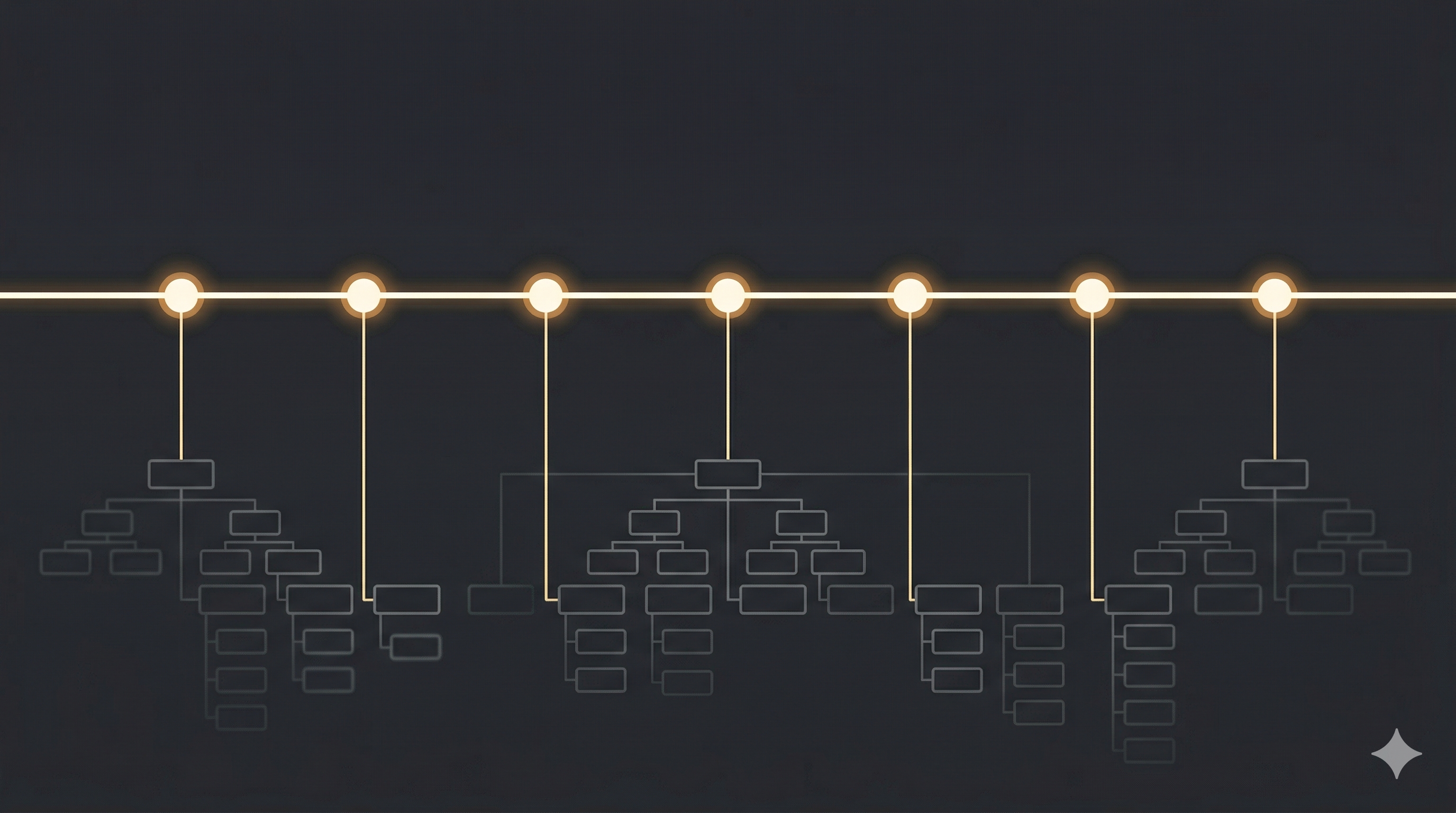
That gives you two axes. Horizontal: the customer journey - the sequence of stages a customer moves through from first contact to retention. Vertical: the business functions that touch those stages. Plot them against each other and you get a clear picture of where AI absorbs the overhead without touching what the department actually exists to deliver - and where handing something to AI means giving away the thing that makes the function worth having.
The Business Functions on the Vertical Axis
These are the nine layers assessed in the matrix below. Each is present, to some degree, at every stage of the customer journey:
- Customer Communication - any outbound message to the customer: confirmations, updates, responses, proactive outreach, retention messages.
- SOP / Procedure Execution - rule-based operational tasks that follow a defined logic: validations, eligibility checks, routing, calculations, status updates.
- Personalization & Recommendations - adapting content, offers, or next steps to the individual customer based on behavioral or transactional data.
- Pricing & Eligibility - applying pricing rules, discount logic, and access conditions to a specific customer or transaction.
- Escalation & Complaint Handling - identifying when a situation exceeds standard handling and routing or resolving it appropriately.
- Cross-department Coordination - moving context, decisions, or data between functions so the customer experience stays coherent across handoffs.
- Process Improvement - identifying friction, surfacing patterns, and proposing or testing changes to how work gets done.
- Department Authority Layer - the decisions that define what each department fundamentally exists to do: pricing strategy, claims judgment, commercial terms, risk assessment. The work that cannot be delegated without the function losing its reason to exist.
- AI Oversight & Control - setting decision rules, reviewing supervisor flags, authorizing prompt changes, owning accountability when automated systems produce consequential outputs.
How to Read the Matrix
Each cell combines a classification with a concrete example of what that looks like at that journey stage. The four classifications:
- AI Fully handled by AI. The task is execution - consistent, rule-followable, language-dependent work where human involvement adds process time but not judgment. AI handles this without meaningful loss of value.
- Guided AI does the analytical work and drafts the output. A human reviews and approves before it reaches the customer or triggers a consequential action. The risk of a wrong output exceeds what unsupervised automation should own.
- Supported A human owns the decision and the outcome. AI provides relevant context, drafts, or signals to make that human faster and more consistent - but does not drive the conclusion.
- Human Core domain authority. This is what the department uniquely exists to contribute: judgment, accountability, strategic discretion. Delegating it to AI means the organization loses something real - not just a process step, but the source of value.
One distinction worth making explicit before reading the table. Customer Service refers to the operational team handling tickets, complaints, refunds and direct interactions - the people in the queue. CX refers to the broader Customer Experience discipline: the function that owns journey design, loyalty strategy, quality standards and the end-to-end customer relationship. In many organizations these sit inside the same department. Strategically, they are doing different work - and the matrix treats them differently.
| Business Function | Awareness | Consideration | Purchase | Post-purchase | Support | Return / Refund | Loyalty |
|---|---|---|---|---|---|---|---|
| Stage Owner | Marketing + Product |
Product + Marketing |
Product + Revenue |
Ops + Product |
Customer Service + Product |
Customer Service + Finance |
CX + Marketing |
| Customer Communication | AICampaign reply handling |
AIProduct Q&A chat responses |
AIOrder confirmation & receipt |
AIShipping updates & delays |
GuidedDraft reply, agent reviews & sends |
GuidedEmpathetic message, reviewed before send |
AIRe-engagement sequences |
| SOP / Procedure Execution | AIGDPR consent & cookie logic |
AIInventory availability check |
AIAddress validation, payment retry |
AITracking dispatch & status sync |
AITicket classification & routing |
AIRefund eligibility check |
AIPoints balance calculation |
| Personalization & Recommendations | AILookalike audience targeting |
AIBrowse-based product recommendations |
AIUpsell & cross-sell at checkout |
AINext purchase suggestions |
GuidedRetention offer based on history, reviewed |
GuidedRecovery offer, agent approves before send |
AITier-based reward messaging |
| Pricing & Eligibility | GuidedPromo rules applied, Revenue reviews |
GuidedDynamic pricing display, approved |
GuidedDiscount eligibility, human confirms |
SupportedPrice adjustment claim, agent decides |
SupportedGoodwill credit amount, human approves |
GuidedRefund amount calculated, reviewed |
GuidedReward tier threshold applied |
| Escalation & Complaint Handling | AISpam / abuse auto-filter |
AIFAQ deflection before agent queue |
GuidedPayment failure escalation path |
GuidedDelay complaint routed, agent reviews |
SupportedComplex case summary, agent owns outcome |
SupportedDispute context compiled, human leads |
GuidedChurn risk flagged, retention team reviews |
| Cross-department Coordination | SupportedCampaign brief shared across teams |
SupportedProduct & marketing handoff summary |
SupportedOrder exception alert to Ops |
SupportedFulfillment delay flagged to Customer Service |
SupportedCase context passed to Finance |
SupportedReturn status synced across systems |
SupportedSegment data shared with Product |
| Process Improvement | SupportedDrop-off pattern surfaced |
SupportedConversion gap flagged |
SupportedCheckout friction identified |
SupportedDelay root cause report generated |
SupportedResolution time analysis produced |
SupportedReturn reason clustering |
SupportedChurn predictor model output |
| Department Authority Layer | HumanBrand positioning decisions |
HumanAssortment & merchandising strategy |
HumanCommercial terms & pricing strategy |
HumanCarrier & SLA commitments |
HumanPolicy exceptions & claims judgment |
HumanDispute resolution authority |
HumanLoyalty program design & rules |
| AI Oversight & Control | HumanCampaign AI prompt governance |
HumanRecommendation model review |
HumanCheckout logic accountability |
HumanFulfillment AI audit ownership |
HumanSupervisor flag review & response |
HumanRefund logic sign-off |
HumanRetention AI decision rules |
Classifications are indicative. Exact placement depends on industry, regulatory context, and risk appetite.
Why the Top Rows Are So Green
Customer Communication and SOP Execution are AI across almost the entire journey. It is worth being precise about why - because it is not simply that AI is "good at" these tasks in some general sense. It is that the skills these roles have historically required are exactly what large language models are architecturally built around.
Think about what a strong customer communication role historically needed:
- Multilingual fluency - the ability to write clearly and correctly across multiple languages, adapting tone per market
- Consistency at scale - applying the same standards across hundreds of daily interactions without drift
- Procedural recall - knowing which policy applies to which situation and translating it into a customer-friendly message
- 24/7 availability - being present at the moment the customer needs a response, not the next business day
- Tone calibration - adjusting warmth, urgency, and formality based on context
These are not human strengths. They are human constraints that organizations built processes around. AI does not just replicate them - it removes the constraints entirely. A model does not get tired at message 400. It does not lose consistency across languages. It does not miss a procedure because it was on holiday last week when the policy changed.
The green cells are green not because the work is unimportant but because the characteristics that made humans necessary for this work are no longer the binding constraint. Keeping people in those roles is not a quality decision - it is a habit carried over from a different set of technical conditions.
The Columns That Should Make You Uncomfortable
Look at the Support and Return columns. They carry more Guided and Supported cells than any other stage. That is not coincidental. These are the moments where a customer has already had something go wrong - where the emotional stakes are higher, the liability exposure is more direct, and the consequences of an AI error are not an inconvenience but a relationship damage or a legal exposure.
The journey does not just tell you what functions AI can handle. It tells you where the risk profile changes, and therefore where unsupervised automation needs to give way to human judgment. The org chart never showed you that. It showed you who owned the function - not what the function cost when it went wrong at a specific point in the customer experience.
The Bottom Two Rows Do Not Move
Department Authority Layer and AI Oversight are Human across the entire journey. This is not caution. It is the logical end of the same reasoning that makes the top rows green.
If AI absorbs all execution work from a Revenue team - eligibility checks, discount logic, pricing display - what remains is the work that defines what a Revenue function is for: deciding where to hold margin, where to sacrifice it, how to respond to competitive pressure. That judgment cannot be delegated to an inference point without the organization losing its ability to make deliberate commercial decisions. The function no longer exists as a strategic asset - it becomes a governance wrapper around machine outputs.
The same logic applies to AI Oversight. As the green area grows, so does the need for humans whose job is not to execute within the AI layer, but to own its behavior - setting decision rules, reviewing supervisor flags, absorbing accountability when automated systems produce consequential outputs at scale. That role does not disappear as AI matures. It becomes more important.
The Consistency Supervisor sits at the handoff points the matrix makes visible - specifically the transitions between AI and Guided cells, and between Guided and Supported ones. Each of those transitions is a potential context collapse: a point where one inference point hands off to another and semantic state either carries forward or restarts from scratch. Part 3 goes into how to build and operate the supervisor at those exact points. For now the important observation is this: the journey map tells you precisely where to deploy it. You do not need to monitor everything - you need to monitor the transitions.
What the Framework Is Actually Asking
Every department has a version of the same question to answer: of all the work we currently do, what is the work that makes us irreplaceable? What would be lost - not in headcount terms, but in value terms - if everything else were handled by AI?
The matrix is a tool for making that question concrete rather than philosophical. When you plot your functions against the journey and start classifying cells, you will find that the Human area is smaller than most departments expect, and the AI area is larger than most leaders are comfortable admitting. That discomfort is worth sitting with. It is pointing at the gap between the structure the organization has and the structure the technology now makes possible.
What sits in the Human cells - Department Authority Layer and AI Oversight - is not overhead. It is the core. Everything above it, in the green and yellow cells, is the overhead that has historically been inseparable from it. AI is separating them. The organizations that recognize that early are the ones that will redesign around their actual value rather than defend the structure that used to contain it.
What Part 3 Covers
The matrix answers where AI should operate and where it should not. Part 3 addresses what happens once it is running across all those cells simultaneously - how the Consistency Supervisor threads through the transition points, how to govern the Guided cells without creating a human bottleneck that defeats the purpose of automation, and how to detect when the architecture is quietly degrading before the damage reaches the customer.
Part 2 of a three-part series. Read Part 1 here or the full series overview here.